
Wedding Planning Without Stress: Breaking Free from the Decision Loop
Constantly second-guessing decisions you’ve already made? Here’s how to break the decision loop in wedding planning.
TikTok, Instagram, and Pinterest weighing in? Here’s how to plan a wedding that feels like *you*—with real priorities and a clear framework.

You’re newly engaged, open Pinterest for the first time, and suddenly it’s all there at once: a hundred styles, seventy DIY projects, thirty ideas for guest favors, plus ten lists of things that supposedly must be at every celebration. TikTok suggests a ceremony on the Amalfi Coast, Instagram a guest list the size of a festival. What started as excitement feels, after ten minutes of scrolling, like a to-do list you never signed up for.
Here’s the thought that makes everything easier: Your wedding doesn’t need to fulfill anything. It just needs to feel like you. And that’s something entirely different from recreating a collection of beautiful images.
The feeling of constantly missing out isn’t random. Social media doesn’t show your celebration—it shows the highlights of a thousand strangers’ weddings. Every saved idea becomes a silent expectation you supposedly need to meet. Add in well-meaning opinions from family who all know how to do it "right," and the pressure builds.
And the feed doesn’t sort by realism—it sorts by clicks. The more you see the biggest and most expensive, the more normal it seems.
The problem isn’t usually the individual idea. It’s the sheer volume. Twenty great concepts at once don’t create a cohesive celebration—they just create the feeling that you could never do enough.
An event doesn’t get better the more you pack into it. It gets better the more it sounds like you.
Many of the weddings you’re measuring yourself against follow different rules. For celebrities and influencers, the event is often a revenue stream: content, collaborations, new followers. What would be pure expense for you is part of their business model. What looks like the norm is sometimes just their job.
When you ask guests years later about a wedding, they almost never remember the color scheme of the napkins. They remember the feeling in the room, the moment when everyone cried or laughed, the people. That’s where your energy is worth spending.
Before you think about the venue or decor, answer one question: Who truly needs to be there? Not who is expected, but whose presence would make the day complete for you. The guest list is the one decision that influences almost everything else—from the size of the venue to the budget. Clarifying it first removes pressure immediately.
And if the list ends up shorter than you thought? That’s a good thing. A small wedding isn’t a compromise—it’s a choice for intimacy.
Guest List & RSVP Manage your guests, send invitations, and keep track of all responses. DiscoverAtmosphere isn’t created by more decor—it’s created by you feeling comfortable. A couple that’s relaxed sets the tone for the whole room. So ask yourselves less, "What looks good?" and more, "What makes us feel like ourselves?" Sometimes that’s a playlist of your favorite songs instead of a live band. Sometimes it’s a small ritual only you understand. Small, authentic details always beat big, generic ones.
If you like collecting ideas, write next to each saved image how you want the day to feel. A board with "warm, unpretentious, plenty of time for conversation" will guide you further than one that just looks perfect.
The moments you’ll cherish most are often the unplanned ones. The rain that showed up after all. The speech that went off the rails. These aren’t mistakes—they’re the parts that make your celebration human. Trying to control everything means losing exactly that.
To keep planning calm, a few clear decisions at the very beginning help.
Consciously tune out trends. You don’t have to fight social media. It’s enough to mute certain accounts or set a fixed time window for scrolling each week. If something leaves you feeling smaller rather than inspired after scrolling, let it go. Less input, less noise.
Set a real budget early. Not what’s theoretically possible, but what you’ll still feel comfortable with afterward. Finalize it together with the guest count first. These two numbers are your framework. An honest budget isn’t a sacrifice—it’s a filter that saves you a thousand small decisions.
Choose your food based on you. Serve what you genuinely love. Your favorite cuisine says more about you than any three-course menu that’s "supposed" to be there.
Pick your photographer based on full references. Look at complete weddings, not just the best-of shots. Does the style suit you? Do you feel comfortable with this person? The photos remain long after everything else is packed away.
Here’s perhaps the most effective exercise in all of wedding planning—and it costs nothing: Sit down separately, each with a pen and paper, and write down what truly matters to you for this day. No discussion, no coordination. If you’re stuck, ask yourselves: What do you want to remember in ten years? Usually, it’s a feeling, rarely the number of guests.
Then compare your lists. What’s on both is your core. Everything that doesn’t appear on either list can be confidently crossed off. That’s how you create a clear yes-list and an equally important no-list. This one hour will save you weeks of overthinking later.
The feed doesn’t stop just because you’ve got your lists now. Before saving anything, ask yourselves three questions:
That lakeside venue in Italy looks stunning. But it also means travel for all your guests and a budget that’s missing from somewhere else. Beautiful on screen and beautiful for your life are two different things.
Not everyone will understand why you’re leaving some things out. You don’t have to justify yourself—a simple sentence is enough: "We’re designing the day to feel right for us."
That’s exactly the mindset we built wedset.app for: flexible for any size, honest and transparent, so you can focus on what matters.
Ready to plan your wedding?
Get started for free with wedset.app, your digital wedding planner.
A wedding isn’t a project to check off—it’s a moment to share. You don’t have to do everything that’s possible. You just have to do what feels like you. The feed will forget your day in seconds. The people who were there won’t. Plan with heart, not with endless lists, and the rest will fall into place more easily than you currently believe.
With the guest list. It influences almost everything else, from the size of the venue to the budget. Once you know who truly needs to be there, the rest of the planning becomes much more manageable.
Mute accounts that pressure you and set a fixed time window for scrolling each week. Use references for inspiration, not as a checklist. What matters is only what feels right for both of you.
Because the feed shows what gets clicks, and because many of these weddings are part of a business model. Content, collaborations, and reach fund the event. What’s a revenue stream for them would be pure expense for you. That’s why it’s not a good benchmark.
You sit down separately and each write down what truly matters to you for the day. Then you compare the lists. The overlaps are your core, and everything else can be confidently crossed off.
No. A wedding feels personal through the people and small, authentic details—not the number of handmade items. One detail that means something to you has more impact than ten elaborate projects.
More ideas and experience for the planning ahead.
Constantly second-guessing decisions you’ve already made? Here’s how to break the decision loop in wedding planning.

Why a December wedding counts for the entire tax year, who benefits, and how to secure a registry office appointment in...
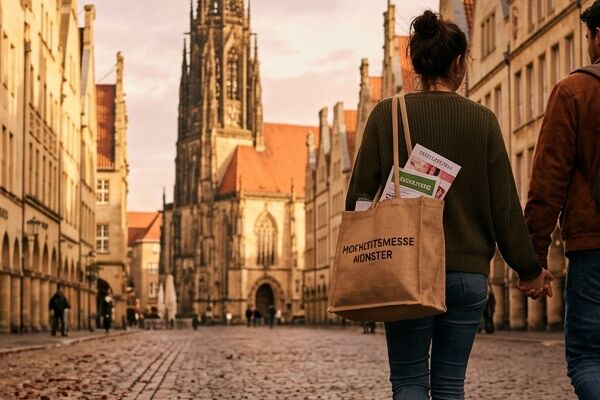
Wedding Days Münster on 7/8 November 2026: Which three numbers to bring, what to ask at the booth, and what you can safe...