

Announcing Your Engagement Without the Drama
Parents, family group chat, or Instagram first? Here’s how to announce your engagement strategically without hurting any...
Big celebration or intimate ceremony? How to decide what fits you as a couple, with emotional insights and practical planning tips.
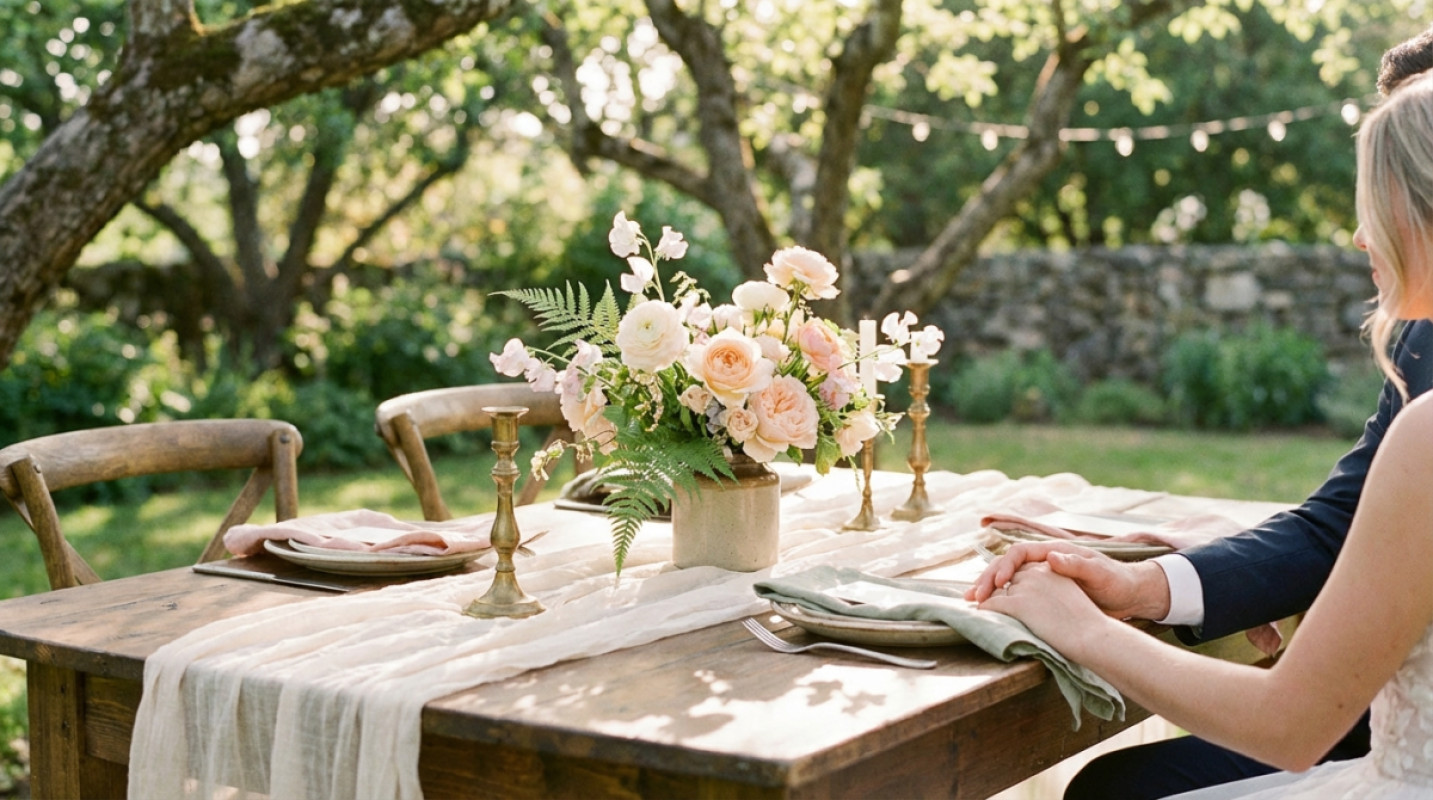
What serves your love better: the pulsing energy of a big celebration or the calm of an intimate ceremony? Many couples feel both. On one hand, the joy of bringing all the important people together. On the other, the wish not to lose the moment in the bustle. That inner tension is normal. It’s not a problem, but a signpost.
Imagine two scenarios we keep hearing in conversations — not as templates, but as mirrors of possible needs.
You have circles of friends from university, sports, work and family who shaped you. A big celebration feels like a thank-you. You want a free (non-religious) ceremony on the estate, a shared dinner, then dancing late into the night. Your heart beats faster when you think of speeches, communal singing and long banquet tables. You want your union to be visible, not just for you, but for your people.
You want to feel every minute. A First Look at dawn, a quiet "I do" by the lake, followed by a long lunch with ten favorite people. You choose deliberate rituals, maybe small handheld comfort tokens that bless you, a poetic vow and a playlist that invites listening rather than partying. No to-dos rushing through, but space for closeness.
Both paths are right. The question is: what nourishes your relationship today — and what will you gladly remember in five, ten, twenty years?
A big celebration supports you. It creates momentum that carries you for months afterwards. People connect, generations start conversations, your story is celebrated collectively. You have many ways to shape it: a civil ceremony or a church service after the registry, live music, a photo booth, a midnight snack. In Germany, Austria and Switzerland the legally required civil ceremony can usually be combined with a later ceremony, often even on a different day.
The flip side: more people mean more decisions. The budget grows quickly, planning requires clear roles and buffers. You become hosts and lovers at the same time. Being present in the moment works when you set deliberate anchors — for example, a 20-minute retreat for the two of you between dinner and dancing.
A small wedding gives you time. You really hear each other and your vows. The day can follow your inner clock rather than schedules. An advantage in the DACH region: many registry offices offer beautiful rooms or ceremony locations in distinctive buildings. Those also planning a free (non-religious) ceremony can find spaces that support intimacy — a mountain hut, an urban studio, or the parents' garden.
The challenge: some worry about excluding people. FOMO is real when Instagram is full of fairy lights and dance floors. But intimacy is not deprivation; it’s a deliberate choice. If you want, you can later host a garden party without having to duplicate everything. Thinking in multi-event terms eases the pressure.
Whether you celebrate with 12 or 120 people: the most fitting decision is the one that protects your relationship. Your love doesn't need an audience to be valid, but it may have one if you both want that. Take time for honest conversations, plan with openness, and create moments where you step briefly out of the bustle. That way your wedding becomes not a format, but a feeling you can return to again and again.
wedset.app helps you plan your dream wedding. From the guest list to the timeline - we have everything under control.
More ideas and experience for the planning ahead.
Parents, family group chat, or Instagram first? Here’s how to announce your engagement strategically without hurting any...

Why a Save-the-Date for 2027 often comes too early—and how to turn your card into a lively conversation with your guests...
Overwhelmed by choosing songs for your wedding? You need fewer than you think. Here’s a relaxed guide based on your day’...