
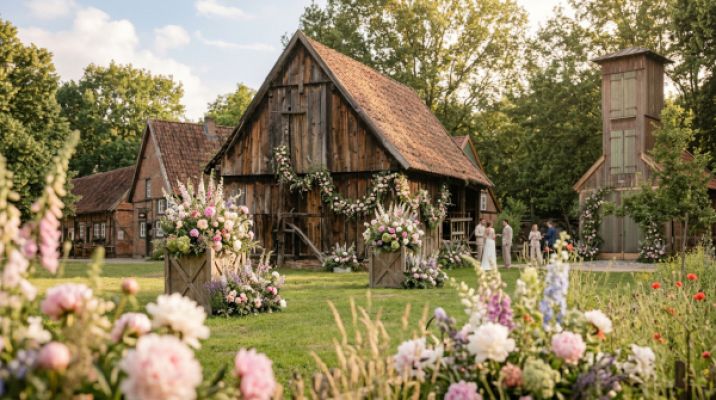
Mühlenhof Registry Office Münster: Only 5 Fridays in 2026
Mühlenhof Registry Office Münster: Why your dream wedding in 2026 depends on just five Fridays—plus real alternatives an...
Münster as an example: How to build a wedding website that truly caters to guests from Berlin, Hamburg, and the surrounding areas—without WhatsApp chaos.
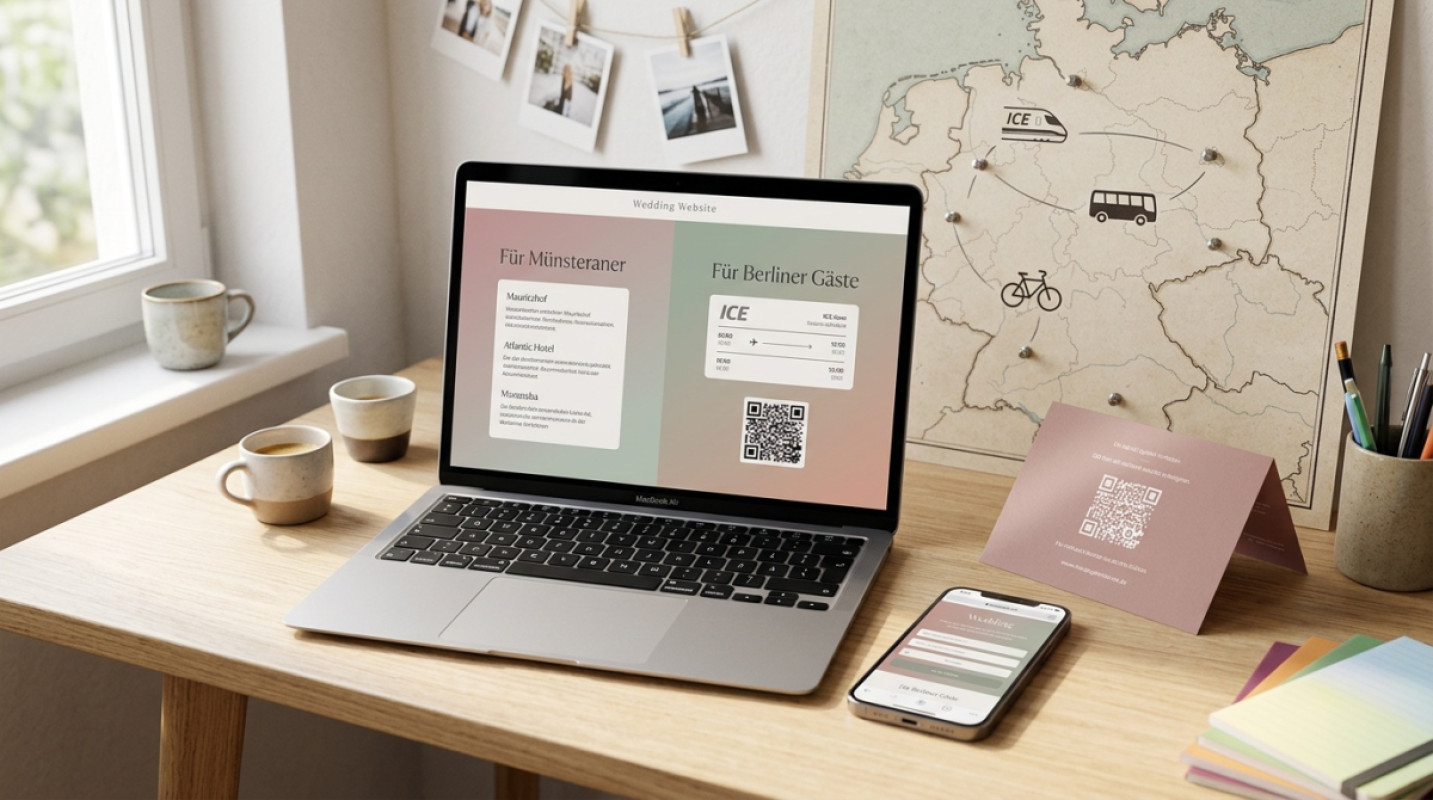
The question of whether you need a wedding website answers itself the moment the seventh cousin from Hamburg asks how to get from the train station to Lotharinger Kloster. Until then, WhatsApp is enough. After that, it’s not.
Anyone who’s ever been in a group chat with 80 people discussing dress code, hotel recommendations, the ICE connection from Vienna, and the question, "Are kids actually welcome?" at the same time knows: This form of communication doesn’t scale. Especially not when your guests are traveling from three different German states (or more) and each region needs different information.
Take Münster as an example—because this city illustrates almost everything couples underestimate when dealing with a regionally mixed guest list.
Locals don’t need directions. If you live in Münster, you know where Lotharinger Kloster is, and you’re not surprised that parking is available at Hörsterplatz or the Theater parking garage. This group wants to know: dress code, timing, whether the cocktail reception outfit is enough, or if a jacket for outdoors makes sense.
Guests from Berlin spend four hours on the ICE, may have to transfer in Hamm or Osnabrück, and frantically Google hotels two weeks in advance. From Vienna, it’s nearly nine hours, which means a completely different travel logic. Hamburg? Direct connection, but unsure if they’ll catch the last train back.
Three groups, three different information needs. One WhatsApp group can’t handle this without half the messages getting lost in mute mode.
A good wedding website isn’t a vanity project. It’s the only answer for 80 people who all don’t know the same things.
An honest travel section is more than just the sentence, "We’re excited you’re coming." It’s a collection of concrete, verifiable details that you research once and never have to explain again.
For Münster as an example location, this looks like:
The beauty of a website? You can organize this info into separate sections. Out-of-town guests read the train section, locals scroll straight to parking. No one is overwhelmed with details they don’t need.
In Münster, hotel blocks are realistically booked six months in advance—earlier during peak seasons. Hotels like Mauritzhof, Atlantic Hotel, or Klosterpforte are popular and fill up quickly.
On your website, communicate three things:
A QR code on the invitation leads directly to the hotel section. This saves you from constantly sending booking links, and guests can find the info even three weeks later.
Some topics simply don’t belong in an open chat. Not because they’re secret, but because they need to be organized, written down, and easily accessible.
This is where many couples give up and revert to the WhatsApp group: the implementation.
With a block editor like the one offered by wedset, you can create separate sections for different guest groups without the page feeling cluttered. A travel block for out-of-town guests, a parking block for locals, an FAQ block for the usual questions. Each section stands on its own.
The QR code on the printed or digital invitation leads directly to the website. No typing, no copied links in family chats, no "Send me the link again." If someone is looking for an address or vendor recommendation, wedset also offers local providers in Münster that you can integrate directly into your planning.
The RSVP function replaces the Excel spreadsheet you’d otherwise maintain manually. Guests confirm attendance directly on the page, note allergies, and select menu options. You see the status in real time without sorting through 80 individual messages.
Wedding Website Create your personal wedding website — with all the details for your guests. DiscoverYour website should be live at least three months before the wedding. Six months is better if you’ve sent save-the-dates with a QR code. Have two or three friends from different regions proofread it beforehand—someone from Münster, someone from Berlin, someone from the south. A guest traveling from Vienna will spot gaps you’d never notice.
And then? Sit back and relax. The website does the work while you finally get to talk about something other than whether the ICE from Hamburg is running on time.
Ideally six months before the wedding if you’re sending save-the-dates with a QR code. At the latest, it should be live three months beforehand so out-of-town guests have enough time to book train tickets and hotels.
Create separate sections: one for locals with parking info, one for travelers with train connections and hotel blocks, and one with general details like dress code and schedule. This way, each group finds exactly what they need without scrolling through irrelevant info.
Dress code, gift preferences, the kids question, allergy inquiries, and emergency contacts. These details need a fixed, accessible place—not a chat where they disappear after three days.
Absolutely. A QR code lets guests scan directly to the website without typing long URLs. It works especially well for printed invitations and save-the-dates.
wedset.app helps you plan your dream wedding. From the guest list to the timeline - we have everything under control.
More ideas and experience for the planning ahead.
Mühlenhof Registry Office Münster: Why your dream wedding in 2026 depends on just five Fridays—plus real alternatives an...

Getting married in September 2027? Here’s the honest order of what to book starting June 2026, including the registry of...
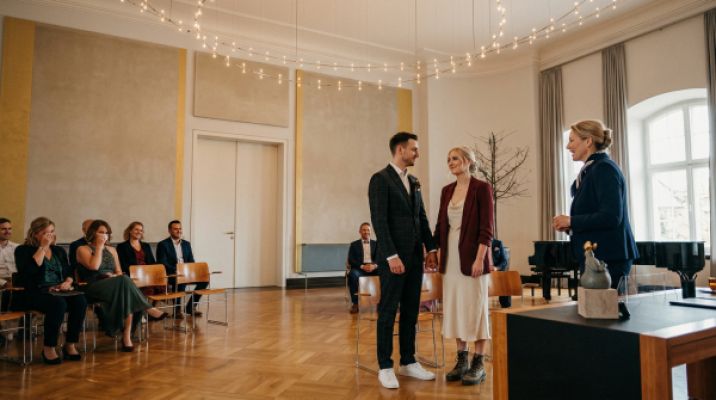
Insider tips for Münster Registry Office: the predecessor effect, the 30-minute rule, zoo weddings, and everything offic...