Wedding seating plan Your uncle doesn't get a seat until step five
Before that come the easy seats: your table, your witnesses, the uni friends. By the time it's his turn, you can already see where there's room.
Free for 30 days. Paper and scissors work too.


Everyone with a yes has a seat
How to make a seating plan in six steps: Replies first, gaps last
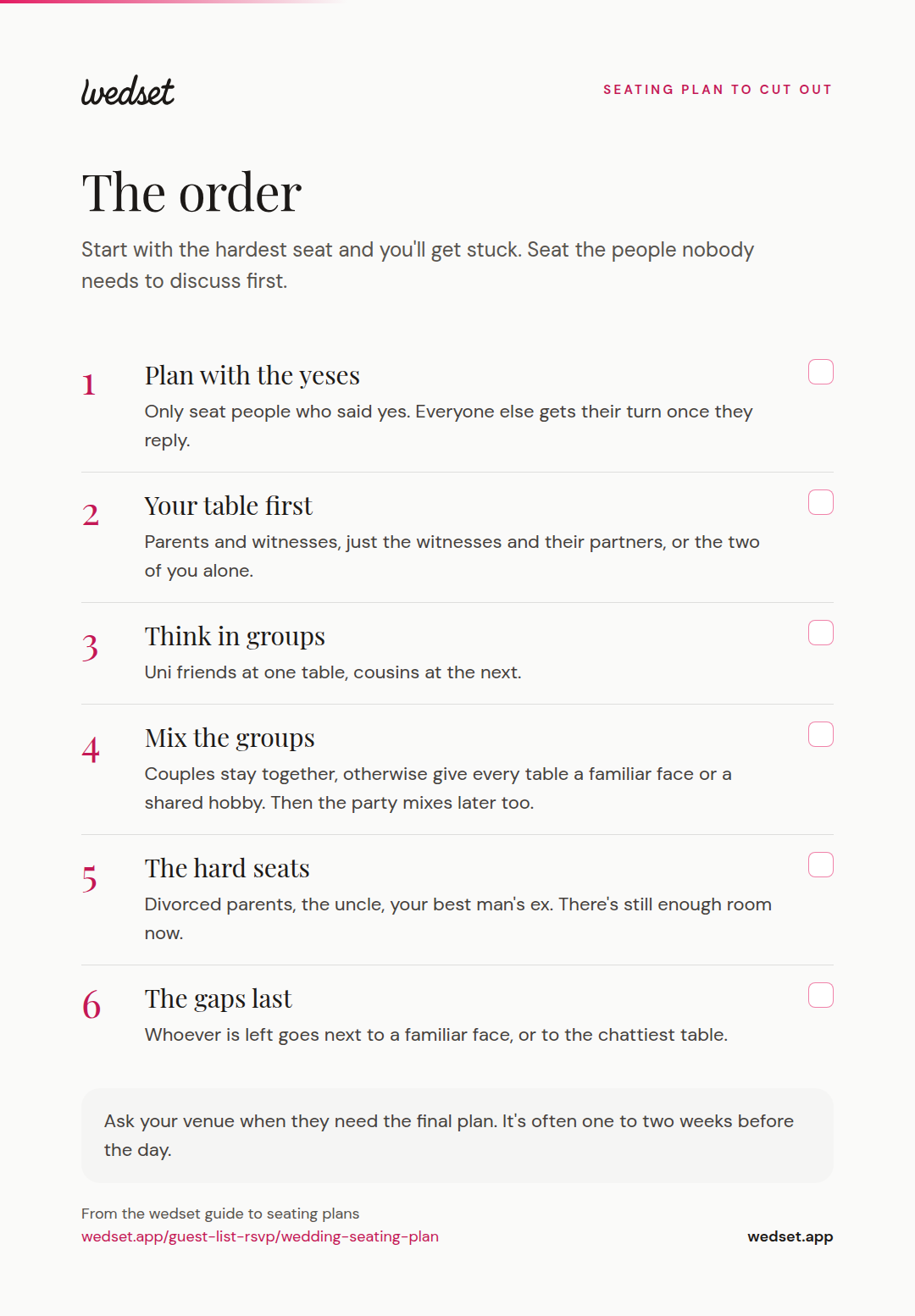
Start with the hardest seat and you'll get stuck. Seat the people nobody needs to discuss first.
-
Plan with the yeses
Only seat people who said yes. Everyone else gets their turn once they reply.
In wedset
No retyping, the yeses are already in.
-
Your table first
Parents and witnesses, just the witnesses and their partners, or the two of you alone.
In wedset
Your venue sees your table first.
"Especially important"
-
Think in groups
Uni friends at one table, cousins at the next.
In wedset
Couples and families stay together.
-
Mix the groups
Couples stay together, otherwise give every table a familiar face or a shared hobby. Then the party mixes later too.
In wedset
You decide who gets to know whom.
"Keep them close"
-
The hard seats
Divorced parents, the uncle, your best man's ex. There's still enough room now.
In wedset
The plan keeps feuding guests apart.
"Give them space"
-
The gaps last
Whoever is left goes next to a familiar face, or to the chattiest table.
In wedset
Everyone else is seated in one click.
"Seat everyone automatically"
Ask your venue when they need the final plan. It's often one to two weeks before the day.
Why 100 guests are 300 decisionsFree seating chart template as a PDF: The seating plan for your kitchen table
In case wedset isn't for you yet
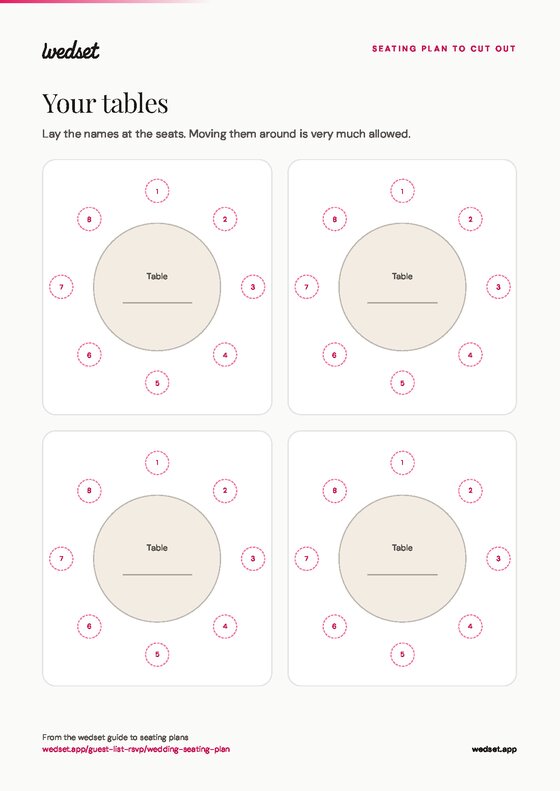
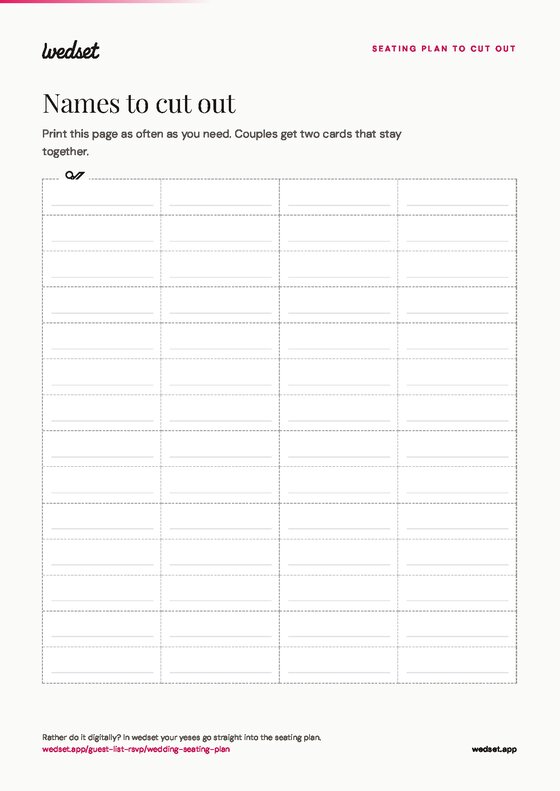
Print the PDF and cut out the name cards. Then lay them on the tables and move them around until it works.
Four pages
- 1 · The order
- 2 · Room on a metre grid
- 3 · Tables
- 4 · Name cards
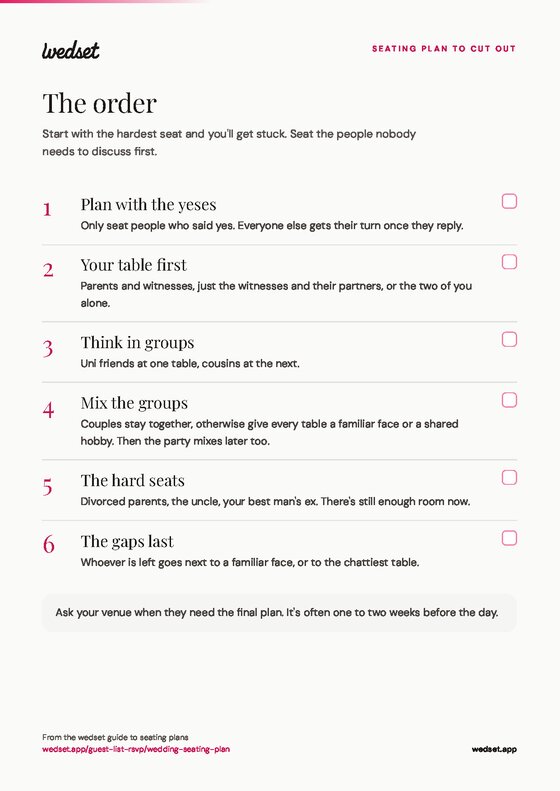
The image shows just the order, to keep on your phone.
Seating etiquette for the tricky ones: The seats that give you a headache
Almost every family has one or two. This usually works.
-
Divorced parents
Each parent gets their own table, both equally close to you.
New partners sit with them. Tell both how you're doing it beforehand.
In wedset: "Give them space"
-
The uncle who fits nowhere
Next to the person he knows best.
Even if that isn't a family table. At least he'll talk there.
In wedset: "Keep them close"
-
Two who can't stand each other
Separate tables are usually enough.
Just not back to back at neighboring tables.
-
Guests who don't know anyone
Next to the person who talks the most.
Or with people who share a hobby. Two newcomers at a table settle in faster than one on their own.
-
Kids
Little ones sit with their parents, older kids love their own table.
Within sight of their parents and away from the aisle.
Kids at the wedding: the case for and against -
Grandma and grandpa
Close to the toilets and the exit, away from the speakers.
And where they can see you.
-
Photographer, DJ, officiant
A seat and a meal, near the exit.
They work for you all evening and need to slip out now and then.
-
Late yeses
Leave one seat free at two or three tables.
Then nobody has to squeeze in.
In wedset: "Not seated yet"
Kind ways to remind guests to reply
Wedding table calculator: How many tables for 80 guests?
Enter your number and pick a table shape. It's the same calculation the wedset seating planner starts with.
Table shape
Seats per table
10 round tables
80 guests ÷ 8 seats = 10 (rounded up)
Room: about 14.5 × 11.5 m, including chairs and walkways
How this table calculator works: number of guests divided by seats per table, rounded up. 80 guests at round tables of 8 need 10 tables and a room of about 14.5 × 11.5 m.
Which table shape suits your guest countSeating plan app: Dad and Uncle Bernd get a seating wish
You note who belongs together and who needs a little distance. The plan sticks to it when it seats people and when you move them.


-
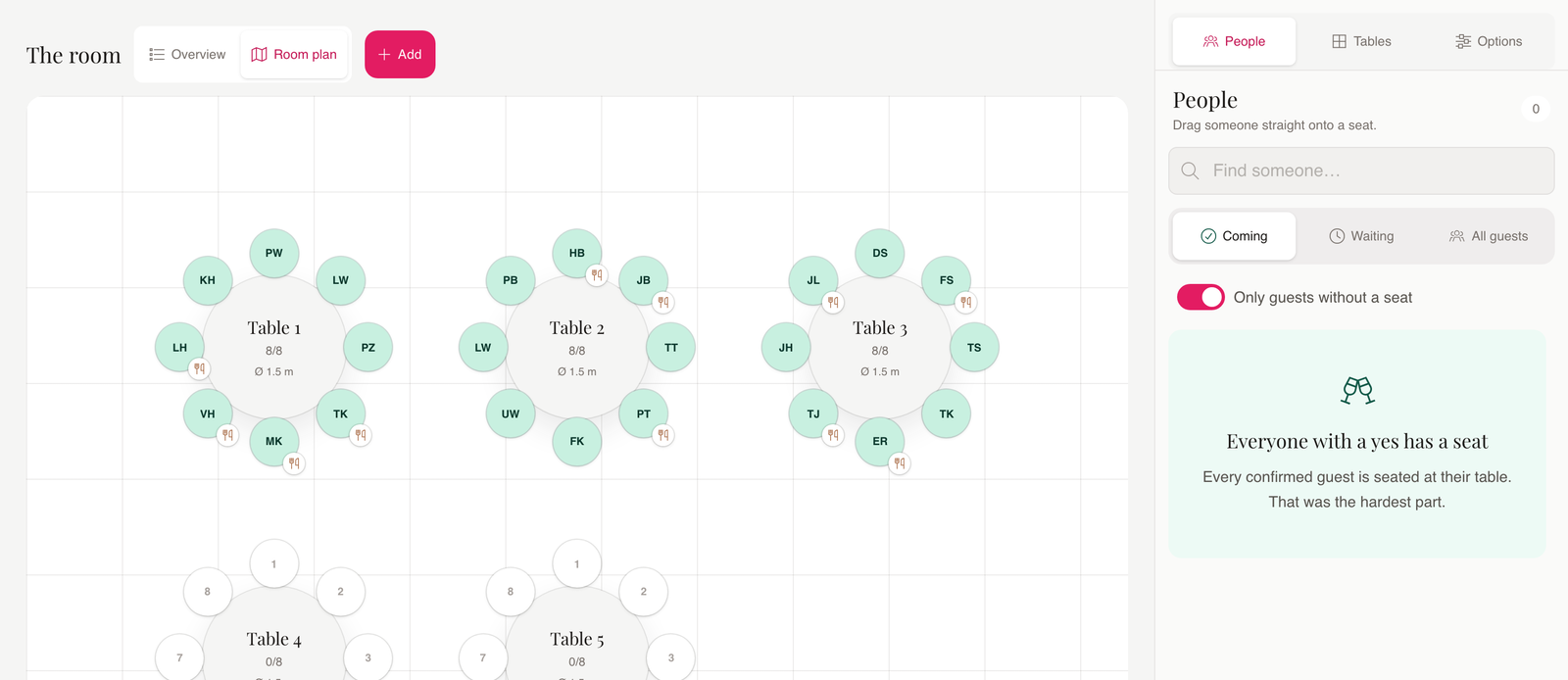
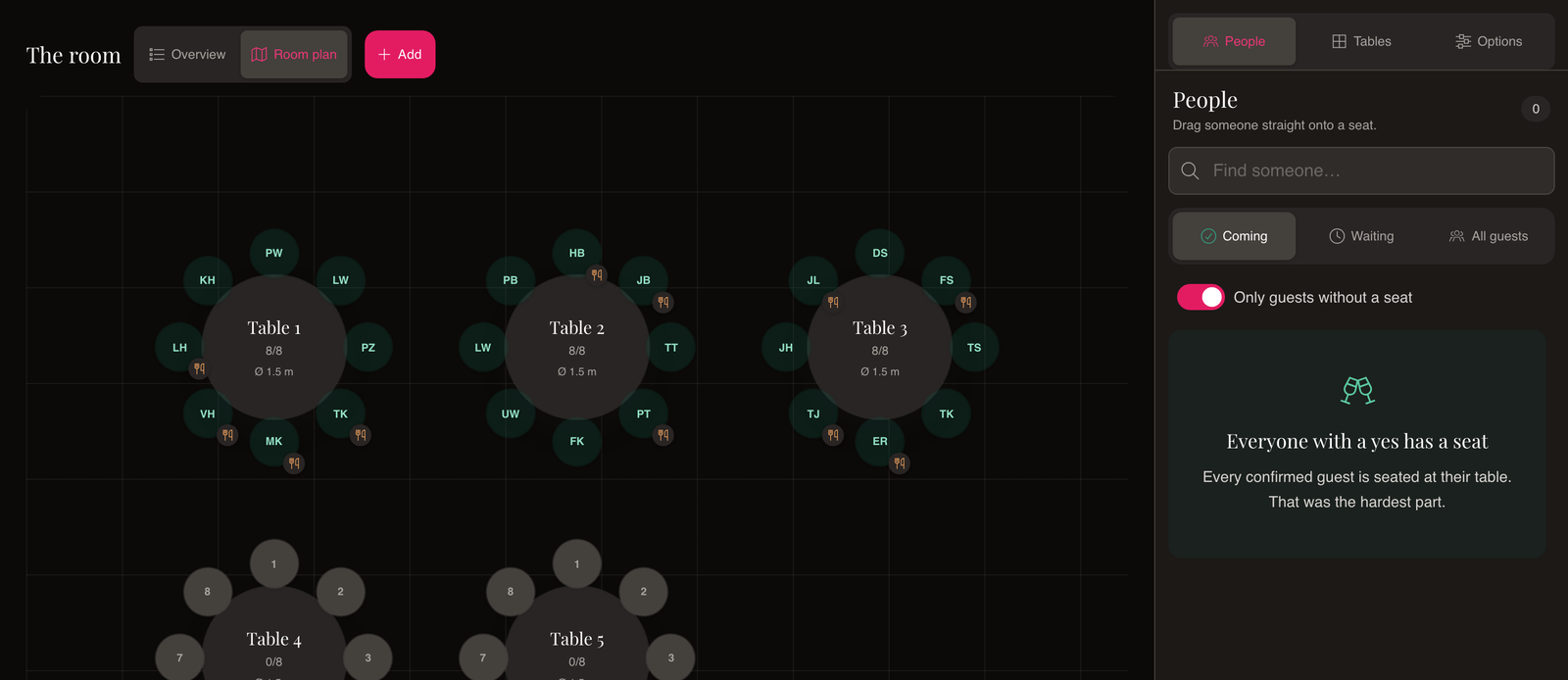
Room plan
In the room plan you drag people straight onto their seat, on your phone you tap them. You can try a second version without losing the first.
-
Not seated yet
Your seating plan only shows people who said yes. Anyone who replies later lands under "Not seated yet".
-
For your venue
Your venue gets a PDF with seats and dietary needs per table, or a link that always shows the latest version.


Quick answers: Still wondering about the seating plan?
Where do the parents sit at a wedding?
Classically at your table, crossed over so each sits next to their child's new partner. Just as good: they host their own tables close to you, especially when they're divorced.
Who sits at the top table with the couple?
That's your call. Parents or witnesses with their partners are common. Some couples sit on their own at a small table.
When should you make the seating plan?
After your RSVP deadline, once most replies are in. Ask your venue when they need the plan, often one to two weeks before the day.
Do you even need a fixed seating plan?
For a served dinner it helps a lot, otherwise someone ends up standing. A middle way: you assign tables only, and everyone picks their own seat there.
Round tables or one long table?
Groups mix more easily at round tables, and at a long table you talk to more people.
Should couples sit next to each other or opposite?
These days mostly side by side, and at round tables anyway. Classic etiquette puts couples across a corner or opposite each other, so both get talking to others. At a long table either works.
Is there a printable seating plan template?
Yes, as a PDF with the order, a room plan on a metre grid, tables and name cards to cut out. Free and without signing up.
Does the seating planner cost extra in wedset?
No, the seating planner is part of wedset.
And if Tom says yes after the plan is done?
Then you give him a free seat in wedset, and the link for your venue shows the update. Free for 30 days.